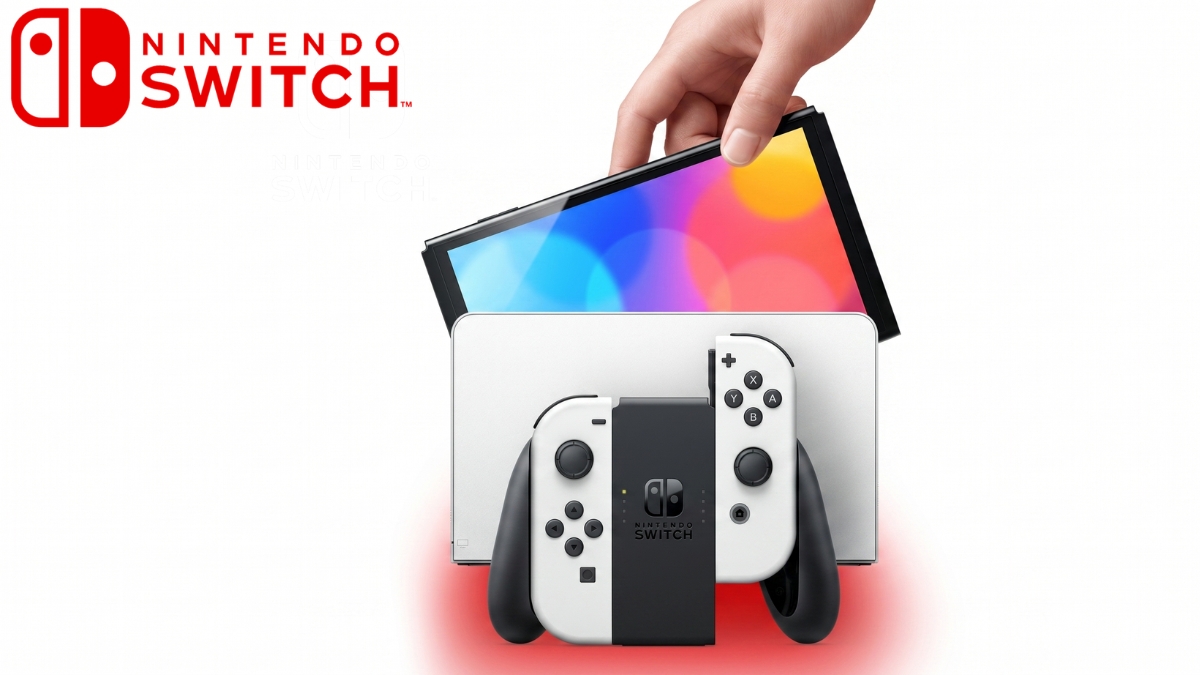
Nintendo’s Switch lineup spans three distinct hardware configurations — the Switch OLED Model, the standard Nintendo Switch, and the Nintendo Switch Lite — each designed for a different kind of player. The official Nintendo comparison page makes clear that these aren’t merely cosmetic variants. Screen, play modes, storage, dock features, size, battery life, and price differ meaningfully across the three. This article breaks down every spec, explains the real-world implications of each difference, and tells you exactly which model fits which use case.
The Three Models at a Glance
| Nintendo Switch – OLED Model | Nintendo Switch (Standard) | Nintendo Switch Lite | |
|---|---|---|---|
| Current US MSRP (after Aug. 3, 2025 adjustment) | $399.99 | $339.99 | $229.99 |
| Release | October 2021 | March 2017 (revised 2019) | September 2019 |
| Screen | 7.0-inch OLED, 1280×720 | 6.2-inch LCD, 1280×720 | 5.5-inch LCD, 1280×720 |
| Storage | 64 GB | 32 GB | 32 GB |
| Battery | 4.5–9 hours | 4.5–9 hours | 3.0–7.0 hours |
| Weight (with Joy-Con) | 0.93 lbs (421g) | 0.88 lbs (399g) | 0.61 lbs (277g) |
| Play Modes | TV, Tabletop, Handheld | TV, Tabletop, Handheld | Handheld only |
| Joy-Con | Detachable | Detachable | Integrated |
| Dock included | Yes (with LAN port) | Yes (no LAN port) | No |
| Kickstand | Full-width, adjustable | Small, fixed-angle | None |
Screen: The Most Important Difference
This is where the models diverge most dramatically for handheld play.
The OLED Model’s 7.0-inch OLED panel produces true blacks by turning off individual pixels rather than using a backlight. The result is sharper contrast, more vivid color saturation, and deeper shadow detail compared to any LCD panel. The screen is also 0.8 inches larger than the standard model’s 6.2-inch LCD and 1.5 inches larger than the Lite’s 5.5-inch LCD.
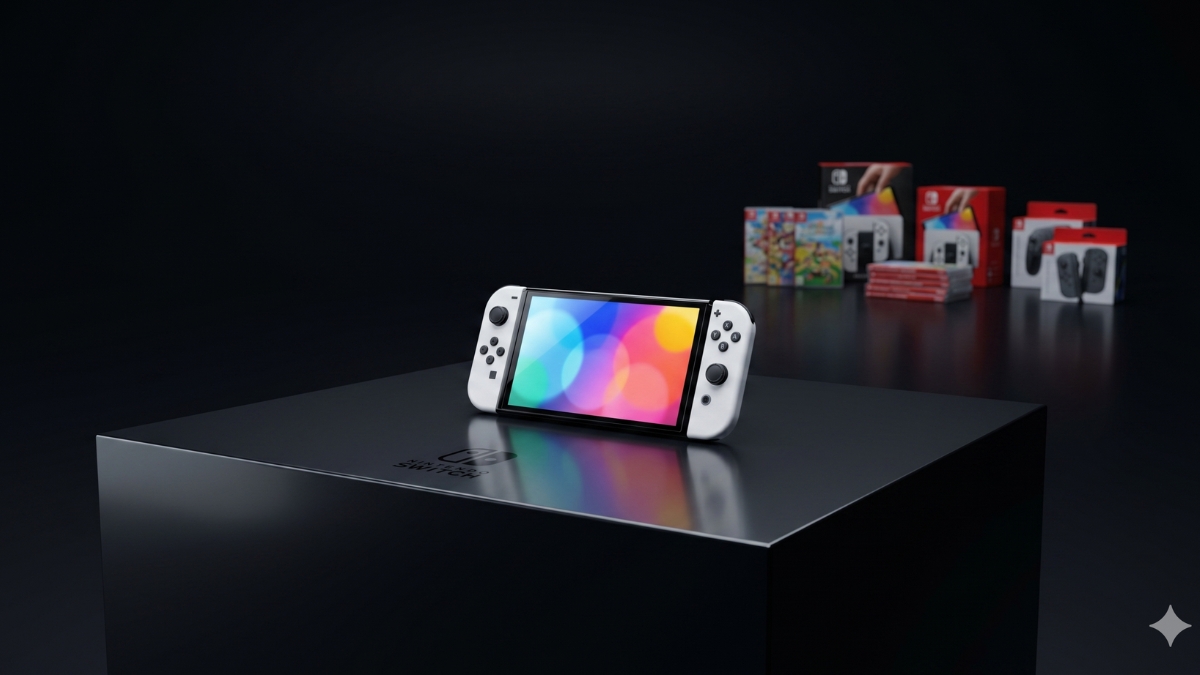
Critically, all three models share the same 1280×720 resolution. Pixel density is highest on the Switch Lite (its smaller screen compresses the same pixels into a tighter area), while the OLED Model’s larger panel has the lowest pixel density of the three — but OLED’s display characteristics more than compensate in perceived image quality.
For TV mode, the screen type is irrelevant. The OLED and standard Switch output up to 1080p in TV mode via HDMI. The Lite has no TV output at all — its USB-C port is for charging only.
Play Modes and the Dock
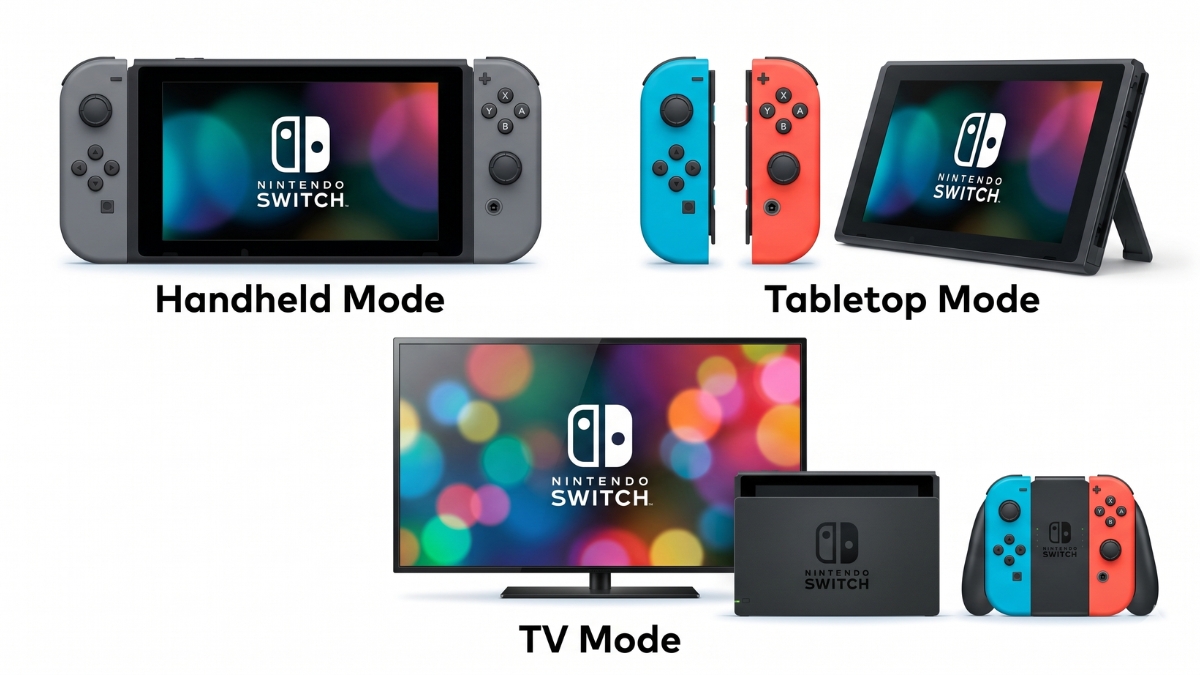
The OLED Model and standard Switch support three play configurations:
- TV Mode — Console docked, output through HDMI at up to 1080p
- Tabletop Mode — Console propped using the kickstand, Joy-Con detached for nearby multiplayer
- Handheld Mode — Console held in hand with Joy-Con attached
The Switch Lite supports only Handheld Mode. It cannot connect to a TV. For games that do not fully support Handheld Mode, or that rely on detached Joy-Con features, separate compatible controllers may be required — and the Lite still will not output to a TV.
The OLED’s New Dock
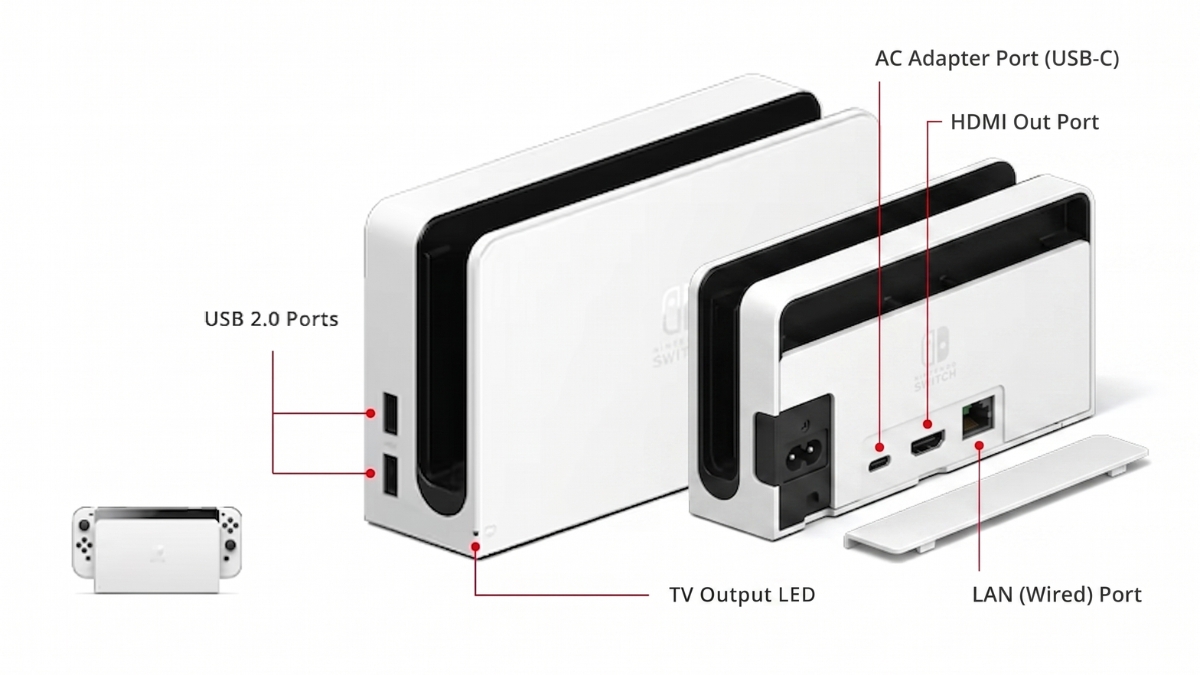
The OLED Model ships with an updated dock that includes a built-in wired LAN port, eliminating the need for a USB LAN adapter previously required for stable online play. The standard Switch dock has no LAN port and requires that third-party adapter (approximately $15–30) to access wired internet. The OLED dock is also cross-compatible — a standard Switch can be connected to the OLED dock to gain LAN access.
The standard dock provides three USB 2.0 ports (two on the side, one on the back). The OLED dock provides two side USB 2.0 ports plus the LAN port.
Storage
| Model | Internal Storage | MicroSD Support |
|---|---|---|
| OLED Model | 64 GB | Up to 2 TB (microSDXC) |
| Standard Switch | 32 GB | Up to 2 TB (microSDXC) |
| Switch Lite | 32 GB | Up to 2 TB (microSDXC) |
The OLED Model’s 64 GB is double what the other two offer — enough for several smaller games or a few large downloads before a microSD card becomes useful (a portion is also reserved by the system). On any model, a microSDXC card is the practical solution for library management. Once inserted, a system update is required (internet connection needed).
Internal Hardware: CPU, RAM, and Performance
All three Switch 1 models share the same processor family:
- CPU/GPU: NVIDIA Custom Tegra processor (Nintendo’s official description for all three models)
- RAM: 4 GB LPDDR4
- System RAM reservation: Approximately 1 GB reserved for OS functions
Nintendo does not advertise any CPU or RAM performance difference between Switch 1 models. All three run the same game code at the same frame rates and resolutions. Performance differences in games are environmental, docked mode enables slightly higher GPU clocks, not hardware-model-specific.
Battery Life
| Model | Battery Capacity | Estimated Range |
|---|---|---|
| OLED Model | 4310 mAh | 4.5–9 hours |
| Standard Switch (2019 revision, serial XKW) | 4310 mAh | 4.5–9 hours |
| Standard Switch (original, serial XAW) | 4310 mAh | 2.5–6.5 hours |
| Switch Lite | 3570 mAh | 3.0–7.0 hours |
The 2019 revision of the standard Switch, identifiable by serial numbers beginning with “XKW”, matches the OLED Model’s 4.5–9 hour range through chip efficiency improvements. The original 2017 launch Switch runs 2.5–6.5 hours on the same battery due to the older Tegra X1’s higher power draw. Nintendo uses The Legend of Zelda: Breath of the Wild as their battery life benchmark: roughly 5.5 hours on the OLED and revised Switch, 4 hours on the Lite.
All three models charge via USB-C and reach full charge in approximately 3 hours (in sleep mode).
Physical Dimensions and Weight
| Model | Dimensions (with Joy-Con) | Weight |
|---|---|---|
| OLED Model | 4.0″ H × 9.5″ L × 0.55″ D | 0.93 lbs (421g) |
| Standard Switch | 4.0″ H × 9.4″ L × 0.55″ D | 0.88 lbs (399g) |
| Switch Lite | 3.6″ H × 8.2″ L × 0.55″ D | 0.61 lbs (277g) |
The OLED Model is 0.1 inches longer than the standard Switch — negligible in practice, though it may affect fitment in some third-party cases and grips designed for the original model. The Switch Lite is substantially smaller and lighter, making it the most portable of the three.
Connectivity
All three models share the same wireless specification:
- Wi-Fi: IEEE 802.11 a/b/g/n/ac (dual-band)
- Bluetooth: 4.1
- NFC: Present on all models (for amiibo functionality)
- Headphone jack: 3.5mm 4-pole stereo (all models)
- USB-C: All models; the Lite uses USB-C for charging only, not dock connectivity
Sensor differences:
The OLED Model and standard Switch include an accelerometer, gyroscope, and ambient brightness sensor. The Switch Lite has only the accelerometer and gyroscope — no brightness sensor.
Game Compatibility
OLED Model and Standard Switch
Both are compatible with the full Nintendo Switch game library. The OLED Model has a noted exception: it does not cleanly fit within all Nintendo Labo kit designs due to its slightly larger dimensions.
Switch Lite
The Switch Lite can play all games that support Handheld Mode. Games without Handheld Mode support, or games relying on detached Joy-Con features, may require wirelessly connected controllers (sold separately) and still won’t display on a TV. When using separate Joy-Con controllers, a charging solution such as the Joy-Con Charging Grip is required since the Lite has no Joy-Con rail.
To check a specific game’s compatibility before purchasing, consult the game’s packaging or the Nintendo eShop listing for the handheld mode icon.
Current Pricing Context (US, Post-August 2025)
In August 2025, Nintendo raised prices across the Switch 1 family in the US. Nintendo’s official statement cited “market conditions” as the reason; reporting at the time connected the move to tariff pressure on imports from Vietnam, where Nintendo handles a significant portion of its production. The increases:
| Model | Original MSRP | Current MSRP |
|---|---|---|
| Switch OLED | $349.99 | $399.99 (+$50) |
| Standard Switch | $299.99 | $339.99 (+$40) |
| Switch Lite | $199.99 | $229.99 (+$30) |
These increases also narrow the value gap between the Switch 1 lineup and the Nintendo Switch 2, which launched at $449.99. The OLED Model is now just $50 below the Switch 2’s base price — a relevant consideration for first-time buyers.
Who Should Buy Which Model
Nintendo Switch – OLED Model is the right choice if you primarily play in handheld or tabletop mode and value screen quality. The OLED display is a meaningful upgrade for handheld gaming. The included LAN-equipped dock and 64 GB of storage strengthen the overall package. It is the most refined version of the Switch 1 experience.
Standard Nintendo Switch makes sense for players who spend most of their time docked to a TV, where the OLED screen advantage disappears entirely. At $60 less than the OLED, the performance in TV mode is identical. Confirm you’re buying the revised 2019 model (serial starting with XKW) for the better battery life.
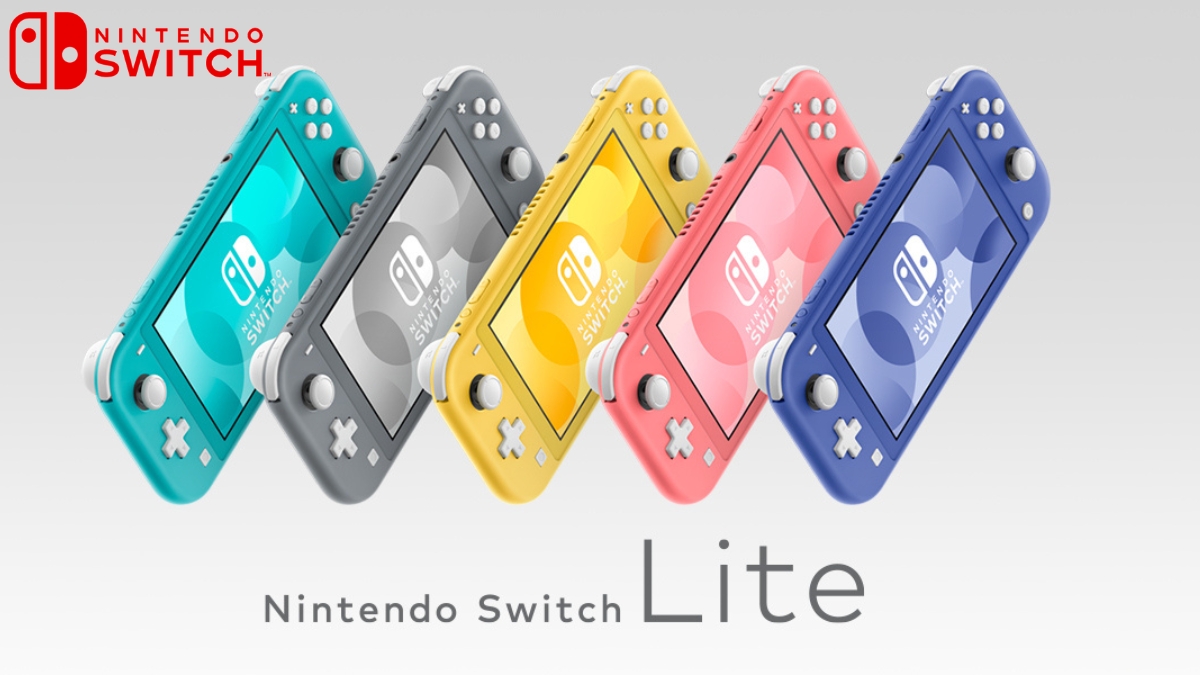
Nintendo Switch Lite is the correct pick for players who will never use TV mode — children, commuters, or dedicated portable-only gamers. Its smaller size and lighter weight are genuine advantages. The significantly lower price accommodates a larger game budget. Verify game compatibility before purchasing titles, as some games have handheld-mode or controller-feature restrictions.
Skip all three if you’re a new buyer primarily interested in future Nintendo software. The Switch 2 has launched, supports most physical and digital Switch 1 games (check Nintendo’s compatibility page for exceptions), and its $449.99 price is now only marginally above the OLED’s $399.99 MSRP.